Analysis of the Assumption of Liability for E-Merchants in IPR Disputes in China, I

—Interpretations on Solutions to Several Issues in Hearing E-Commerce IP Infringement Cases

(By Luo Yanjie) In recent years, E-Commerce in China has thrived along with the development of online shopping. According to some news reports, the volume of the transactions from 360buy.com totaled more than RMB sixty billion Yuan, and Suning’s online sales achieved a comparatively paltry RMB 18.336 billion Yuan. With respect to Taobao.com and its affiliated websites, their business gains have vastly superseded all other rivals. By November 2012, Taobao.com and Tmall had sales of over RMB 1000 billion Yuan, which is almost three times that of Bailian Group, Suning and Gome’ s annual income in 2011 combined. The aforesaid three companies are currently the top three retail chains in China.

READ MORE

How Do Chinese Courts Distinguish “Manufacture” and “Sale” When Hearing Design Patent Infringement Cases?

360截图-27970776

(By Luo Yanjie) Generally, the manufacture and sale of patented products are easily distinguished. Sale normally refers to infringing sale and purchase of patented products with no engagement in assembly or manufacture. In the case introduced in this essay, however, whether the behavior of the defendant was “manufacture” or “sale” is the key point argued. Now we would like to use the case and relevant law to introduce the difference between design patent “manufacture” and “sale.”

READ MORE

Is it Infringing LV’s Trademark Right when Registering Similar Images as Patented Design?

20130215-周五

(By Albert Chen)  Brief of the case:The Louis Vuitton Company (the “LV Company”) holds the rights to the “LV” trademark in Mainland China, and it registered the trademark “LV” as early as January 15, 1986. At present, the term of protection of the mark has been extended to January 14, 2016. The registered classes for the “LV” trademark include toys, Chinese checkers, Backgammon, golf gloves, etc. On November 13, 2003, Guo filed an application for a patented design called “Mahjong (23)”, and the application was approved and published on July 14, 2004. The published patent includes 5 pictures, which contain the front view, left view, back view, top view and three-dimensional views. Among them, the front view contains an image consisting of the letters “L” and “V.”

READ MORE

Who Has the Burden of Proving “Profit After Tax” When Calculating Remuneration for a Patented Invention?

(By Albert Chen) In the previous post, the author introduced how to determine the unit granted the patent right by looking at a case decided by a Shanghai court. Today, the author will use a case from a Guangdong court to introduce how the court there held on who must prove “the profit after tax” when a dispute breaks out on invention remuneration payable by the unit granted the patent right.

Summary of the case:

The employee inventor, Mr. Zhu, worked for Dongguan Wei Ba Cleaning Equipment Co., Ltd (the “Wei Ba Company”) from 1998 to 2006. During his employment, Mr. Zhu participated in the development of sixteen patents and was also registered as a joint inventor in the company’s patent applications. Afterwards, the Wei Ba Company exercised some of the patents but did not pay Mr. Zhu any remuneration. For this reason, Mr. Zhu filed a lawsuit against the Wei Ba Company, claiming that remuneration payable for his invention should be calculated based on the 2004 Annual Joint Inspection Report that the Wei Ba Company submitted to the Ministry of Commerce, which indicated the company’s total profit after tax. Moreover, Mr. Zhu claimed that the remuneration shall be calculated for the past two years.

READ MORE

Shall Parent Company Make the Payment for Subsidiary Employees’ Invention for Hire?

(By Albert Chen) In past essays, the author has introduced the legal issues related to the establishment of remuneration for inventions developed under work for hire schemes, and payment of said remuneration. Through a study of two recent cases, the author has found that the comments made by the judge in them is of reference value when deciding the “unit granted the patent right” and the “one liable to prove after tax profits”. In the meantime, the author would like to share his interpretation and analysis in these two posts.

READ MORE

New Rules on the Protection on the Patent Made for Hire in China

(By Albert Chen) In previous posts, we introduced our readers to ways to pay remuneration for the invention made for hire, and the standard adopted by Chinese courts in related disputes. On 26th November 2012, the State Intellectual Property Office (the “SIPO”), accompanied by 12 other authorities, jointly released the “Several Opinions on Further Strengthening the Protection of Service Inventor’s Legal Interests and Promoting IPR Implementation (the “Opinions”), which demand a strengthened protection on the rights of service inventors in several aspects. In today’s post, you will be able to become more familiar with the main points contained within the Opinions.

READ MORE

How Chinese Courts Determine Remuneration for Employee Inventions?

(By Albert Chen) Yesterday’s post introduced regulations concerning calculation and payment of remuneration for the invention made for hire. The post also pointed out problems in the existing law, both at the by the central government and local level, namely that they lack binding authority, have low enforcement, or provide inadequate regulation on the liability of the unit.

The author has conducted research on these points in the established cases in China and found a case decided last year by the Guangdong High People’s Court (“Guangdong Court”), which is of referential value to settling the above problems.

READ MORE

How Should Chinese Businesses Pay Remuneration for Inventions Created by Their Employees?

(By Albert Chen) Statistics have shown that since 2007, the invention made for hire have comprised over half of China’s patent applications, and the number is still increasing. According to Article 16 of the Patent Law: “The unit that is granted the patent right shall reward the inventor or designer of an employee invention. After such patent is utilized, the inventor or designer shall be given a reasonable amount of remuneration according to the scope of application and the economic results.”

READ MORE

How to Record Patents with Chinese Customs?

(By Luo Yanjie) According to the Customs Protection Regulations for Intellectual Property (“Regulations”) patent protection through customs recordation means that customs protects the intellectual property rights related to import and export as well as those rights protectable under Chinese laws and regulations. It generally covers the protection of trademark’s exclusive use right, copyright, and patent. As to trademark protection through custom recordation, you may check our past article “How to Apply for Trademark Recordation in China Customs”. Today we would focus on patent protection through customs recordation.

READ MORE

Key Points to Foreign Company’s IPR Litigation Preparation in China

By Luo Yanjie

With the development of economy, China pays more and more attention to the protection of intellectual property. But whether the patent, trademark or copyright, a lot of high value intellectual property rights belong to foreign companies. Facing the still serious infringing situation, the civil lawsuit is still the most common and reliable means to strike infringement. As for foreign investors, what deserves the attention when preparing lawsuit materials? Today we would like to share the topic with readers as follows:

READ MORE

China Permits Duplication of Life-saving Drugs at Lower Price

By Albert Chen

According to the report of South China Morning Post, the latest revised Measures for the Compulsory Licensing for Patent Implementation (the “Measures”), which has come into effect from 1st May of 2012, China government may sign the compulsory license to the manufacture of the cheap copy of the patent drugs when in the urgency or exceptional conditions of the state, or for the public interests.

Also in the report, it points out that the action by China government is an alert to the world pharmacy industry when China is a prominent part to the global medicine market; especially currently we see a decline in the western countries. Meanwhile, the news also says, for the past decades, many Chinese medicine makers have been manufacturing the important drug ingredient exported to foreign counterparts, who however would afterwards sell the patent medicine made with the aforesaid ingredients to China at a high price which is hardly affordable to Chinese patients. Now China has been focused on its wrestling with foreign drug makers, especially as known, the Global Fund to Fight AIDS, TB and Malaria will no longer grant donation of AIDs prevention to China from 2013.

READ MORE

Data on IPR Development in China, 2011

In recent, the News Office of the State Council held a news conference (note: the link is in Chinese), releasing the data on China IPR development in 2011, and the details are as follows:

Under the unified deployment of special acts by the State Council in combating the IPR infringement and the production and selling of the fake and substandard products, the filed cases in the administration of each level are 155, 900 with the involved amount of CNY 3.43 billion, 1, 702 cases were transferred to judicial organs and 9, 135 shelters were shut down.

READ MORE

SIPO: 172,113 Granted Invention Patent in China 2011

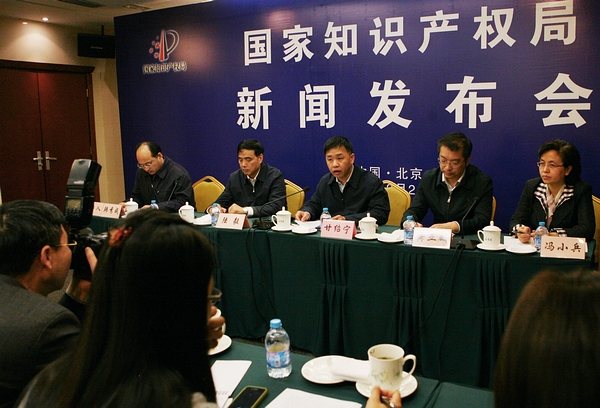
Recently, the State IP Office (“SIPO”) held a News Conference, on which Mr. Gan Shaoning, the deputy director of the administration, announced China’s patent statistic of 2011 (the image above is the picture of the conference ). For your reference, Bridge IP Law Commentary translates the news on Gmw.cn (note: the link is in Chinese) as follows.

I. The Rank of Provinces, Cities and Enterprises on Patent Granting in China, 2011

There has granted 172,113 invention patent by the SIPO in 2011, up 27.4% year to year, among which, 112,347are granted to the inventors at home, namely 65.3% of the total, up 65.3% year to year.

READ MORE

Legal Difference between the Invention and the Utility Model in China Patent Law

Recently, we are consulted by foreign clients the difference between utility model and invention by China Patent Law. Today’s post is Bridge IP Law Commentary’s reply on the question. (the image above is the logo of the State Intellectual Property Office of China, the organ administrating in patent issues)

I. The difference in the scope of the protected object

According to the patent law, the “Invention” means any new technical solution relating to a product, a process or an improvement thereof, while the “Utility model” shall refer to any new technical solution relating to a product’s shape, structure, or a combination thereof, which is fit for practical use. Despite both being the technical solution, the utility model only involves the aspect of shape, structure and other tangible solution, while the inner process or intangible solution, like molecular structure or pharmacy, is included in the invention. Therefore, the utility model shall be included in the invention, thus any invention could also be applied as the utility model.

READ MORE