
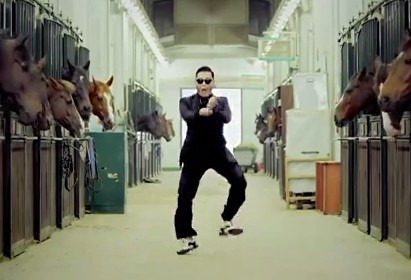
 (By You Yunting) PSY, the most popular South Korean Artist, has achieved more than 1 billion clicks, or views, on Youtube for his music video “Gangnam Style,” and has earned a global reputation. To perform Psy’s signature “horse-riding” dance has become an integral part of domestic corporate annual galas in China. In fact, the partners of our law firm have been encouraged by colleagues to perform the dance for everyone’s amusement. The problem was that none of us could actually perform the “horse-riding” dance properly. When facing such horrible demands from coworkers, a question raised by one of our associates interested me: would a performance of “Gangnam Style” infringe others’ lawful rights?
My conclusion is in accordance with Article 22 of the Copyright Law:
“In the following cases, a work may be exploited without permission from, and without payment of remuneration to, the copyright owner, provided that the name of the author and the title of the work shall be mentioned and the other rights enjoyed by the copyright owner by virtue of this Law shall not be prejudiced: … free-of-charge live performance of a published work and said performance neither collects any fees from the members of the public nor pays remuneration to the performers;”
The laws have explicitly expressed its opinions that, provided a performance is free of charge and clearly indicates the name of the author and the work performed, it can be considered a form of fair use of the work, and no infringement can be established. However, we also see in the law that no other rights shall be infringed at the same time. The following is my analysis on them:
I. The IP rights in “Gangnam Style”
Before discussing infringement of others rights, let us first check how many IP rights have been contained in Gangnam Style as communicated on Youtube.
1. First, the copyright of the video itself. As a musical video showing the performance of the artist, its content appears to be distinctive, and therefore it can be seen as “a works created by virtue of an analogous method of film production.” Thus in regard to public performance (in the sense of broadcasting the video publicly) of the video, the author could initiate the process of rights protection. Sometimes, however, a music video may also be considered a “record” of the video performance, and it would not be protected under copyright law. In that situation, no right of performance could be applied then, and if someone plays it in public, the creator of the video can only protect its right as the right holder of the audio in the video. For our interpretation on this particularly complicated situation, you may check our opinions on it in the latter part of this post.
The difference between a work created by virtue of an analogous method of film production and the work of video recording is that the ones created through an analogous method of film production are considerably more original, creating a stronger likelihood of protection, while the originality in a simple video recording is relatively little, and hence less deserving of protection. In previous cases and precedent in China’s courts, a music video consisting of a singer’s live concert performance was held to be a video recorded work pursuant to Copyright Law. But “Gangnam Style” on Youtube is not simply a recording of a performance, but includes more than 10 scenes, and has undergone cuts and editing. Therefore, its originality is far more obvious, and could be seen as a work created by virtue of an analogous method of film production.
2. The audio copyright. If one removes and separates an audio track from its accompanying video, then it constitutes an audio work, and the holder of it may enjoy audio maker rights.
3. The copyright of the creator. In a work containing both songs and dances, the musical or orchestral part of it may also be protected by copyright on its own. The lyrics, music and dance are individually protected by lyric, musical, and dance copyright.
4. The right of the performer. As the performer, PSY enjoys the right of the performer in law.
II. How to fairly perform “Gangnam Style” in the public?
For the sake of discussion, the author has considered cases where a performance of one’s work would take place, and accordingly, has analyzed possibilities of infringement of one’s performance.
1. Q: Could one invite a professional singer to perform a live show?
A: It would be perfectly fine, provided the live performance is done free of chrage. However, once payment is either made or demanded, then both the performer and the company holding the annual gala will be considered “users” of the copyrighted work. If the actual “Gangnam Style” video from Youtube was performed, then all four aforementioned rights would be infringed upon.
2. Q: Could one play the “Gangnam Style” music video from Youtube while performing?
A: Even for the purpose of an employee performance in the context of a company party, playing the video could incur great risk. As stated before, despite fair use protections for the free performance of another’s copyrighted work, keep in mind such performances must be, in every send of the word, “free.” A public broadcast (or performance) of the actual “Gangnam Style” video, as discussed earlier, would require obtaining permission from the author and/or the copyright holder in order to avoid possible infringement liability.
3. Q: Could one play the audio track of the “Gangnam Style” music video when performing it?
This is debatable. One could analogize this question to a situation where the background music played in a shopping center could also be regarded as a mechanical performance that would impose no charge on customers or those listening to the music. But according to the views of the collective copyright management organizations, this is considered a kind of commercial use, requiring the shopping center to pay a fee to the music producer, and failure to do so would likely result in the shopping center being accused of infringement. If this interests you, you may read up on the case of Mei Lian Mei Supermarket’s infringement against the song “Mother in the Candlelight.” In our fact pattern, once the collective copyright organization determines that the performance of the work as background music would be same as that done by the supermarket in the Mei Lian Mei case, then playing the audio track of “Gangnam Style” would also be deemed a commercial use of a copyrighted work. For that reason, no one can exclude the possibility that the right holder would seek recourse form the company making use of its copyrighted work in an annual gala or company party without prior authorization.
In closing, some readers may accuse the author of being meddlesome. Does it really matter if someone performs the “Gangnam Style” dance at an annual meeting? If the work is freely available online to be viewed by anyone, why wouldn’t one be able to perform it at a company party? Actually, the author’s intention is not to agitate public opinion. This post is to remind everyone that the modern copyright system is complicated and delicate, and that risks stemming from the copyright law should be noted, or one may face great risk when being accused of or held liable as infringing another’s copyright.
Lawyer Contacts
You Yunting:86-21-52134918 youyunting@debund.com/yytbest@gmail.com
Disclaimer of Bridge IP Law Commentary
Short Link: