
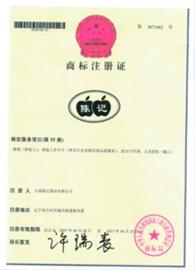
 (By Luo Yanjie) Two companies with a great gap in their relative strength have been seen battling with each other over the trademark of an apple image; they are the globally known Apple Inc. and a fruit food making company in Zhuang He, a small city of China. At the end of the battle, the small company won the fight, Dalian Chenji Guopin Co., Ltd. (the “Chenji”) was supported by the authority in the dispute lasted for 5 years. The dispute was triggered by Chenji’s design, which consists two apples overlapped together, and the Chinese characters “陈记” written on them. In examining the mark, we can find the apple resembles that of Apple’s, which appears to have been bitten by someone. For this reason, Apple filed the trademark opposition with the trademark office.
In March of this year, the Trademark Review and Adjudication Board (the “Board”) of the State Trademark Office judged that the mark of Chenji consists of two apples with the Chinese character “陈记” on them; furthermore, the gap is not specially designed, but made simply by overlapping the apples. Therefore, taking into account Apple’s inadequate amount of proof, Chenji’s application was approved. So far, we have received no news on Apple’s lawsuit regarding the conflict. How then could the world-renowned brand Apple lose this battle? For more regarding our thoughts on this, please check today’s post.
I. Apple has registered no defensive trademark in the Class 31 of fruit
The most direct way for Apple to challenge Chenji’s application is to claim it has made a first application in the classes involved. As checked by the author, Apple did make its trademark application of “Apple” in Class 31 as well as the application of the image mark. But all these applications were refused by the authorities, and are currently in the process of review regarding the refusal.
As stipulated in Article 11 of the Trademark Law:
“[…] those only comprising generic names, designs or models of the goods in respect of which the trademarks are used,”
shall not be granted the trademark right, and the ones applied by Apple are undoubtedly within the description of products in Class 31. Therefore, it is no wonder its application was refused. In addition, once Apple could succeed in its application, due to filing its application later than Chenji, we could see no reason for Apple to challenge Chenji’s application.
II. No abuse use of the trans-class protection on well-known trademark is allowed
Article 13 of the Trademark Law provides that:
“A trademark that is applied for registration in non-identical or dissimilar goods shall not be registered and its use shall be prohibited, if it is a reproduction, an imitation or a translation, of a well-known mark which is registered in China, misleads the public, and the interests of the registrant of the well-known mark are likely to be damaged by such use.”
As a company with a worldwide reputation, its status as being well known is totally beyond question. Could this then be the reason Apple is fighting against a similar trademark application in Class 31? The author thinks the answer is no.
Although a well-known trademark can obtain “trans-class protection”, such protection can only be applied in cases where “the interests of the registrant of the well-known mark are likely to be damaged”. But objectively speaking, no relation can be confirmed between Class 31 and Apple’s reputation. Moreover, to judge the trademarks, despite their resemblance, they could retain an obvious difference between them, and no likelihood of confusion among consumers to mistake products produced by Chenji and Apple, respectively.. Since no confusion can reasonably occur between similar trademarks in different classes, no damages to their individual interests can be certain. For this reason, a well known trademark such as that of Apple’s has no reasonable basis by which it can challenge that of Chenji’s (for the scope of protection of a well-known trademark, you may check our previous post “How Large Is the Scope of Protection for Well-Known Trademarks in China? ”)
III. When Chenji’s trademark infringes the copyright of Apple?
As mentioned above, from the trademark law, Apple will have difficulty in fighting Chen’s trademark. If the “Apple” graphic can be identified as a “work”, can Apple claim Chenji’s trademark constitutes a form of copyright infringement? The author thinks that idea can only be carried out with great difficulty.
It cannot be denied the apple image of Apple is designed by the IT giant itself, and could reasonably be protected under Copyright Law. But unlike regulations in Patent Law, once the development of an image relies on the independent effort of its creator, then that creation can also be considered a work afforded legal protection, even if it looks much like the prior created one. In other copyright infringement cases, due to the complexity of the work, once a similarity among them could be found, the likelihood of copyright infringement is impossible to decide, because it is not easy for a defendant to explain with clarity its creative process.
In this case, because Apple’s trademark itself is a normal apple shape, the so-called similarity is mainly due to the fact that both marks simply represent a similarity in the shape of an apple. In practice, trademarks with two shapes overlapped together are countless, like that of Audi Motors, not to mention the difference between the two trademarks as a whole. In this case, Chenji’s trademark is used in the category of fruit. It is reasonable for them to an apple as its trademark graphic. Therefore, it is hard for Apple to claim copyright infringement by Chenji.
Therefore, from existing trademark query results and news reports, the author supports the committees’ decision. Although the law should protect well-known brands to prevent others from taking advantage of them, this kind of protection must be conformable, and cannot be infinitely expanded, resulting in damage to market competition.
Lawyer Contacts
You Yunting:86-21-52134918 [email protected]/[email protected]
Disclaimer of Bridge IP Law Commentary
Short Link: