
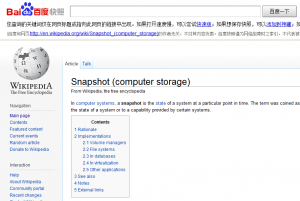
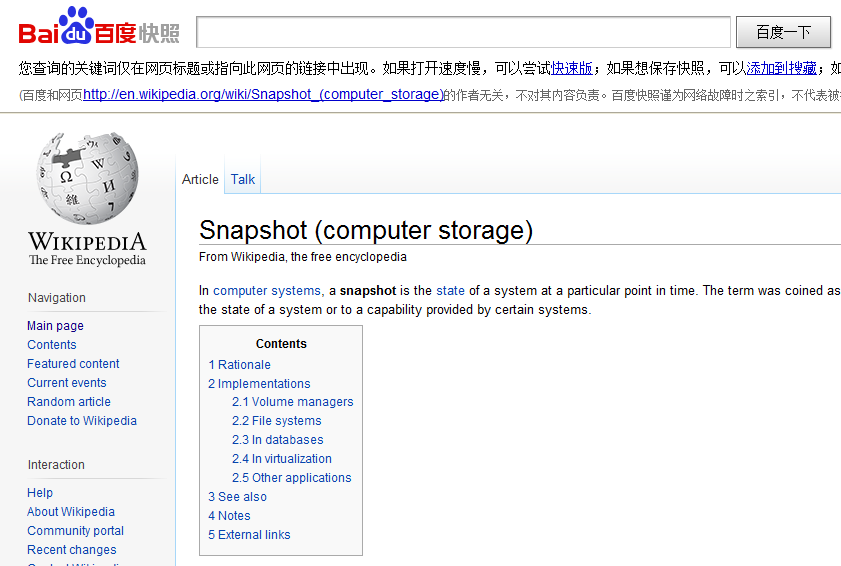
 the Baidu snapshot
By Luo Yanjie
With the increasing sense of legal protection, the copyright owner are paying more and more attention to the infringing works spread in the internet, especially for the ICP of infringing works, like the video search engine and Wenku (namely the online library). But to the annoy of the copyright owners, when the ICP deletes the infringing content, the page may be remained in the snapshot of the search engine available to the visitors, which makes the effect of right protection may be discounted. Today, we would like to share our opinions on the copyright infringement by snapshot of the search engine in this post:
I. Why Article 21 of Protection Regulations on the Right to Information Communication by Networks (the “Protection Regulations”) is not applicable to the snapshot of search engine?
As provided in Article 21 of the Protection Regulations, “when the ISP automatically save the works, performance, video and radio recording from other ISPs and provide such contents to the service object by the technology arrangement for the purpose of the improvement of efficiency of network transmission, as well as the following conditions are met, then such conducts shall not be deemed as infringement and no liability of compensation shall be taken:…”
At the first glance of the regulation, the legal provision may apply to the snapshot of the search engine, but it might not be so from the purpose of legislation. What refers to by the regulation is actually another technology in the internet, namely the cache technology, which is mainly to help the improvement of the internet transmission efficiency, and the main operation model of it is when the user visits a website, the switchboard server of the website will store the page cache of the targeted server, and show the stored page to the user when confirms no update of the target server, thus the duplicate link of the targeted server could be prevented and the band width could be saved. This technology mainly has the following difference to the search engine snapshot:
1. The content of the cache under such technology is not available to its visitor, while the snapshot could be an independent page and be expressed as a link;
2. The content of the cache is updated with those in the targeted website, and therefore when cache will be updated at the same time with the target website with no delay.
Furthermore, for the description in the articles, the snapshot function of the search engine makes no help to the efficiency of the network transmission. And when the user uses the snapshot, the main intention of him/her is to visit the server of the search engine rather than the targeted website. Therefore, the snapshot will bring no speed up when the user focuses on the web-transmission with the purpose of targeted server visit.
So, the above regulation could not be applied to the function of snapshot.
II. What the snapshot shall be covered by the safe harbor rule?
In addition to the aforesaid articles, there could be found no other regulations concerning the snapshot in the Copyright Law or the Protection Regulations. But, in our views, though no specific regulations, the snapshot could also be covered by the safe harbor rule just like other ISP with other liability exemption regulations (like Article 22 and 23 in the Protection Regulations, which says the exemption conditions for the cyber storage provider, search provider and link service provider, namely the safe harbor rule)
1. The search engine will copy and record the pages in indiscrimination with no subjective factors and edition on the pages;
2. The search engine will update the page in a reasonable time;
3. In most situations, the search engine is with no malicious purpose of infringement when providing the snapshot;
4. Most search engine will mark the searched page as a snapshot which is to prevent the confusion among the users.
Despite the content is not developed by the users, what the search engine provides are only the technology service instead of the content by the sense of the user or the intention of the search engine, and therefore the safe harbor rule could be applied in such situations. On the other hand, actually, the courts are following the rule in the practices, like that in the copyright dispute between Wang Lu and Yahoo. In the case, the Beijing No. 1 Intermediate People’s Court finally supported Yahoo although it was also stated in the sentence that the problem remains to be further researched and discussed. (see the written sentence by the court: http://www.panjueshu.com/beijing/gaoyuan/m2008062020071729.html). We hope the legislature could specify such exemption conditions in the legislation with the reference to the case.
III. In which situations will the snapshot be involved in infringement?
Since the safe harbor rule could be applied, the infringement of the snapshot shall be judged whether the there’s any “knowing” or “shall be known” with the following two elements taken into consideration:
1. Whether the search engine deletes the page after the notice of the right owner;
2. Whether the search engine updates the page within the reasonable period;
Also in the dispute between Wang Lu and Yahoo, the plaintiff was refused by the court of her claims for the failure to prove the aforesaid issues.
In fact, most search engines have set up complete complaint channels for their snapshot, and the user may directly complain the snapshot on the page of the search engine. Moreover, by our experiences in the practices, most search engine will delete the snapshot when receiving adequate evidences. Last, we prefer to state that the law shall not hold up and limit the development and application of the technology and for the tech like the snapshot with no intention of purpose to infringement, there shall be not much legal limitation on it.
Other recommended posts on our website:
1. The Actual Term of Trademark Registration in China
2. How to Apply for the Trademark Record in China Custom
3. How to improve the success rate of trademark registration in China?
4. Matters for Attention in Trademark Refusal Review in China
5. Introduction of China’s Legal System of Trademark Renewal
6. Introduction on the Regulations concerning the Capital Contribution in IPR or Domain Name in China
7. The Copyright Registration in China Could Be FREE?
8. China Copyright Protection Term Longer than EU’s?
9. Matters for Attention in the Patent Preliminary Injunction Application in China(I)
Lawyer Contacts
You Yunting
86-21-52134918
[email protected], [email protected]
For further information, please contact the lawyer as listed below or through the methods in our CONTACTS.
Bridge IP Law Commentary’s posts, including the comments and opinions contained herein, shall not be construed as the legal advice on any issues related. The contents are for general information purposes only. Anyone willing to quote or refer the posts to any other publications or for any other purposes, no matter there’s benefits gained or not, shall first get the written consent from Bridge IP Law Commentary and used under the discretion of us. As to the application of the reprint permission for any of our posts, please email us to the above addresses. The publication of this post or transmission of it through mail, internet or other methods does not constitute an attorney-client relationship. The views set forth here are of due diligence, neutrality and impartiality, representing our own opinions only and are our original works.
Short Link: